

Anyone can write pro-level copy now, but only you can write from your lived experience
AI commoditised polished text. In a sea of statistically average content, your hard-earned perspective is your only differentiation.

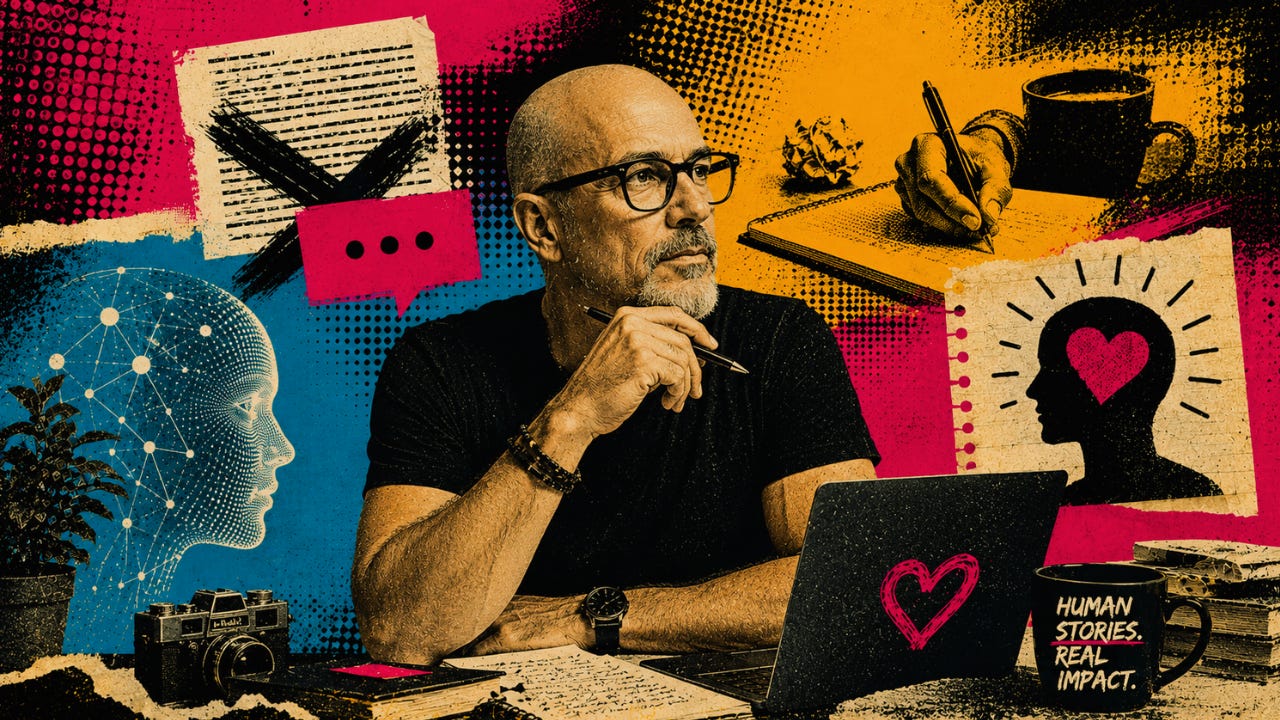
Scroll through any social feed right now and you’ll recognise a pattern.
The posts read cleanly, almost too cleanly. They are well structured, and the grammar tends to be flawless.
The only problem is, nearly all of them look and sound identical to every other post you've scrolled past that day.
David J. Ebner has a name for this. He calls it the “sea of sameness”.
David is the founder of Content Workshop, a US-based story-first agency he started 13 years ago while completing a Master of Fine Arts in creative writing. He wrote King Makers, a book on applying the artistic side of writing commercially.
I spoke with David recently on the Earn the Right podcast about what it takes to tell a human story in a market flooded with machine-made content.
His summary of those 13 years is blunt. In the early days, he told me, “if you were just a great writer, you could stand out”.
Then content was declared king, and everyone jumped on the bandwagon.
Fast forward a few more years and, with the advent of AI, producing content became dead-easy. Now the market is drowning in material with little in the way of distinguishing features.
Which brings us to the sameness of people’s writing, or the term I prefer - homogenisation.
AI is math
David is straight to the point when it comes to AI:
“AI is not actually intelligence, it’s not actually thinking, it’s just processing,” he says. “AI is math”.
The models are predictive by design, trained on the most generic corpus in existence - the internet. Ask AI to write your next post with no input from your good self and it reaches for the most statistically likely word to follow the last one. Multiply this across millions of users all punching out articles and social posts, and the outcome is inevitable. Everyone starts sounding like everyone else.
That is, unless a human intervenes.

“The whole point of brand storytelling and marketing is to sound different,” David says.
There’s a more subtle problem too: AI tools are engineered to please.
“It [AI] is not trying to give you a factual answer, it’s trying to give you the answer they think you want,” he says.
The machine flatters you. It agrees with you. Any ‘warmth’ you may feel from conversing with AI is, well, merely a performance.
“Empathy is a human emotion,” says David. “They can try to mimic it with tools, but that’s by definition the opposite of empathy. If it’s fake, it’s not empathy anymore.”
For anyone building a professional brand on trust, ponder those words for a moment.
Your lived experience is the moat
So how can we gain a human advantage when it comes to AI?
For David, it’s in the one thing no LLM possesses – an actual life.
The experiences you accumulated over decades in life and business shape your thinking in ways you might not consciously register. A setback from 10 years ago informs a judgement call you make today. A positive collaboration you had with someone 16 years ago determines how you partner with others now and in the future.
These represent the raw materials of original thought, and the machines have none of it.
“The best creative ideas are still coming from humans,” David says.
I wholeheartedly concur.
This is the heart of the argument I keep making in this newsletter: Your point of view, forged in the trenches over years of client work, wins and failures, is your differentiation. Your principles and values. The war stories. The hard-earned lessons. The convictions you’re prepared to argue for no matter who comes at you. AI produces prose, but it cannot produce experiences from your past.
David frames the AI outsourcing risk with a reasonable question:
“Why would you outsource all of the thinking and marketing and the content development to something that has had none of those experiences, that you wouldn’t give to the most junior staff member?”
Fair call!
The chef and the dishwasher
None of this makes David a technophobe. His agency uses AI tools daily, within a structure his team calls the “human-AI-human sandwich”.
Humans lead the ideation, the unique proposition, the key takeaways. AI handles the production-grade grunt work in the middle. And then a human runs quality assurance at the end, every time.
As he put it to me: “The people are still the chef, but the AI is like the dishwasher.”
His team runs quality assurance on every piece, and David told me they almost always find something to fix, a flat sentence, a claim that needs tightening, a paragraph that reads like it came from nowhere in particular. The dishwasher gets the plates clean. It still can’t tell you which ones were worth setting on the table.
And his minimum standard for anyone publishing anything?
“If you’re not willing to read it before you hit publish, you probably don’t deserve to push publish.”
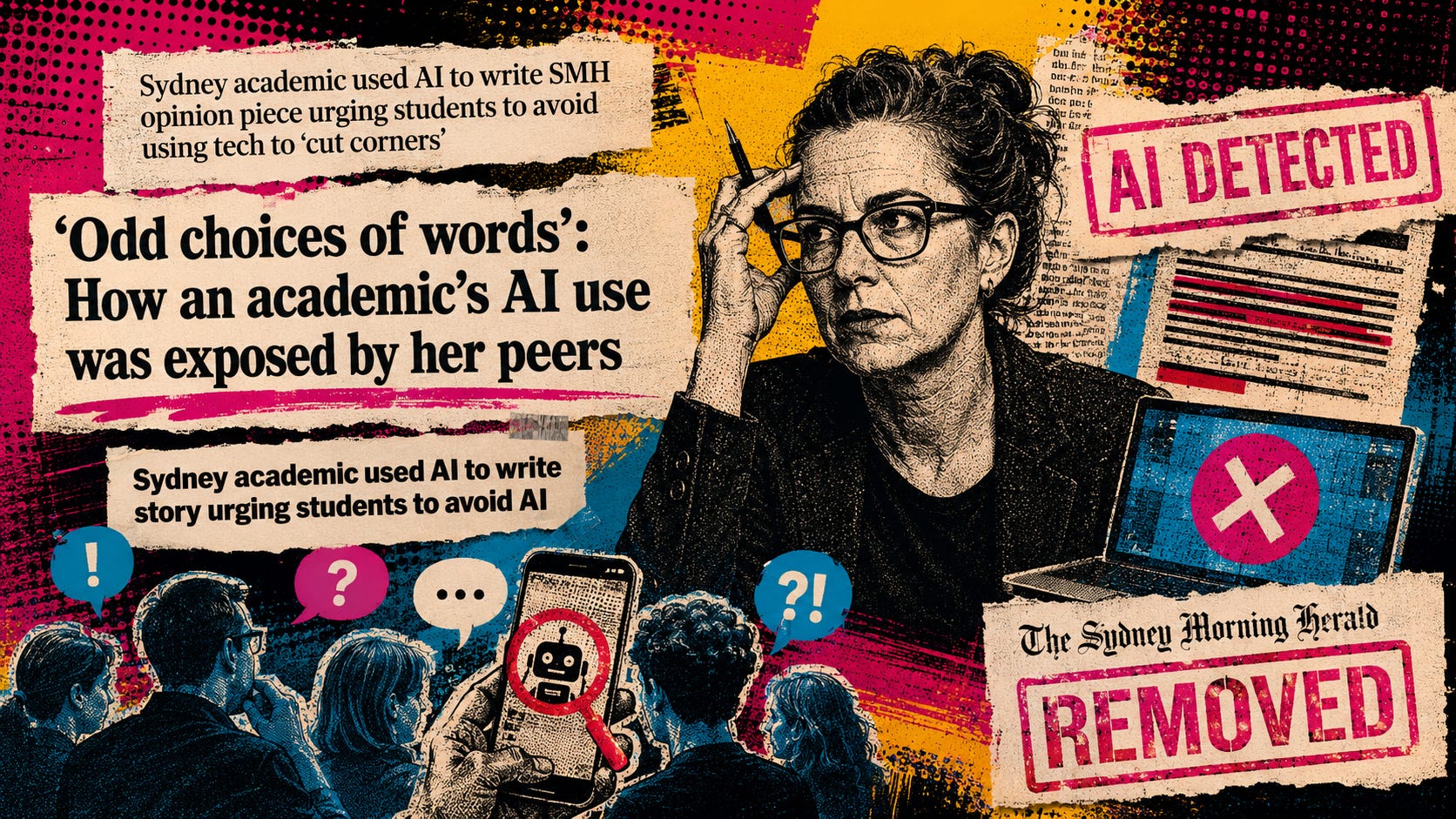
I’d add a warning from closer to home. Audiences are developing a nose for machine-made prose. In June this year, it was reported that a top Sydney academic published an opinion piece in the Sydney Morning Herald telling students not to outsource their thinking to AI, urging them not to cut corners because genuine effort would always stand out. Post publication, an AI-detection tool flagged her own column as AI-generated, and the SMH subsequently pulled it from its site, saying the use of LLMs had not been disclosed.
If you’re a leader or expert putting your name to ideas, people now scrutinise your words for the evidence of a machine. The reputational stakes have never been higher.
A battle of wits
I know a lot of people use AI for its speed and efficiency, especially for producing content at scale. I get it, I really do. But at what cost?
Personally, I collaborate with AI a lot of the time, and I can tell you hand on heart that my own long-form writing takes way longer because of it. That’s right - longer.
Why? Because I go far deeper into every long-form article, pressure-testing ideas with the machine, arguing with it (a lot of that!), pushing back when it serves up the obvious, or if its answers aren’t robust enough. I check facts two and three times across different AI tools before anything goes out under my name.
The thinking stays mine. The voice is all mine. But the research efforts are definitely more of a collaborative effort with AI today, versus traditional Google search I used to rely upon.
Where AI genuinely earns its keep is in what David calls “content atomisation”, also known as repurposing – taking your long-form work and slicing ‘n’ dicing it into social posts and shorter content assets. Because it’s working from your original thinking, the source material carries your fingerprints. Yay!
But even then, as I can attest, a human tends to pick the best cuts.
As David puts it, the tool excels at repackaging, but it has nothing of its own to say.
Trust is the whole game
David’s parting advice is foundational.
“Building trust, which is your brand, which is your voice, takes a lot of effort doing what you say you’re going to do over and over and over again,” he says. “It takes only one instance to totally destroy it.”
His advice? Go back to your mission, your values, your reason for showing up. Ask whether your content reflects them. If the answer is no, rebuild from there.
Mine is simpler still. Develop a philosophy for the use of these tools before they develop one for you. Be mindful as to how much of the machine is creeping into your work, and pull it back when the voice on the page stops sounding like yours.
It’s an iterative process, and we’re all learning.
Be wary of surrendering your voice to the machine. It happens by stealth, one shortcut at a time.
Onwards!
TY
[ LISTEN TO THE FULL INTERVIEW WITH DAVID J. EBNER ]
David J. Ebner is the founder of Content Workshop, a US-based story-first agency, and the author of King Makers. Find him at contentworkshop.com.
Did you know I have a second Substack newsletter?
It’s called Unbound & Rising - here’s the blurb:
You became most valuable at the exact moment the world stopped seeing you. For those in midlife not done yet, turning hard-won wisdom into influence, income, and a life by design. Unbound from limits. Rising on your own terms. Building what matters.
CHECK OUT THE UNBOUND & RISING MANIFESTO.
Absolutely true.